
How to Read BASS
a step-by-step guide

1. Go to your local independent bookstore with three of last year’s hardcover literary novels you couldn’t get into because the first 20 pages made you think of how the plot summaries would sound in Maureen Corrigan’s voice, and trade them in for 2024’s Best.
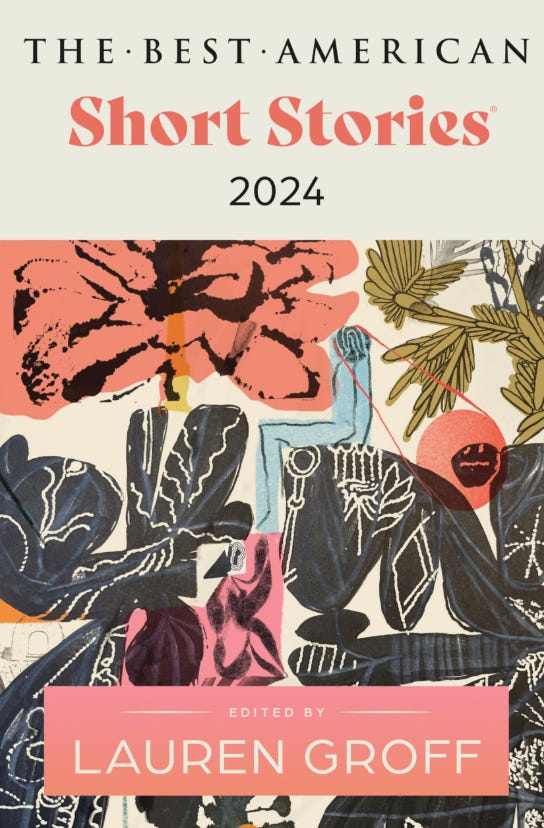
2. Chat about the cover art (not great but better than last year) with the store clerk who you’ve known for a long time because he went to school with your kids. His eyes are the eyes of the child you knew, his face the face of a man.
3. Skim the Introduction. Notes: Groff’s allergic to cats (in stories) and first-person POV; she “grew…tired of the well-made [read: MFA crafty] story.” Quick question for “the imp of the subjective”: is “exquisitely controlled imperfection” imperfection at all?
4. Check the TOC for names you know—some to avoid, some to savor later.
5. Thumb to the back, to American and Canadian [and Irish?] Magazines Publishing Short Stories and look it over; close your eyes and visualize (or call it up, you know you have the tab open) your Submittable submissions and give a little hopeful, agentless nod for next year.
6. Flip to the Other Distinguished Stories and scan around until your eye catches a name, Corinna Vallianatos, who wrote one of the stories you thought was memorable/rereadable in last year’s BASS. Go read Vallianatos’ story, “New Girls,” in the latest issue of BOMB (first line’s iambic):
We stole away to be alone.
7. In 1998, the year I decided to be a writer—to work every day on at least one sentence until a story was finished and then send it to magazines and start another one before the rejections rolled in—I went to the university library and read the first lines of every story published in BASS in my lifetime, noted the ones I thought were best, and went back and read them. It took a year. I’m a slow reader. I recommend this to anyone who wants to write literary short stories.
8. Best American First Sentence of the Second ¶ 2024: Katherine Damm, from “The Happiest Day of Your Life” (81):
This was the second ex-boyfriend’s wedding of the summer.
Cool story. Her contributor’s note (356) is also good.
9. “A Case Study,” by Daniel Mason, beautifully handles the passage of time, but I was primed to like it because my kids are grown and I’ve been thinking of who I was before I knew them (211).
10. That’s enough. Go write your own stuff. Save the rest for a plane.